Introduction
There’s something magical about cooking over an open fire, isn’t there? The crackling flames, the smoky aroma drifting through the air, the gathering of friends and family around dancing firelight. Whether you’re camping in the wilderness, hosting a backyard cookout, or simply enjoying the age-old tradition of fire cooking, the experience connects us to something primal and deeply satisfying.
But here’s the reality that many people don’t think about until it’s too late: open fire cooking is one of the most dangerous cooking methods if you don’t follow proper safety rules. Every year, thousands of people suffer burns, property damage, and even fatalities from outdoor cooking fires that got out of control. Hot grease splatters onto bare skin. Clothing catches fire. Children get too close. Wind shifts and sparks fly onto dry grass.
Does this mean you should avoid open fire cooking? Absolutely not! When done correctly, cooking over flames is safe, rewarding, and creates memories that last a lifetime. The key is understanding the risks and following proven safety protocols.
This complete guide walks you through everything you need to know about cooking on open flames safely. You’ll learn how to choose a safe location, build a controlled fire, use proper protective equipment, prevent burns and accidents, handle emergencies, and cook delicious meals—all without putting yourself or others at risk.
Ready to master the art of safe fire cooking? Let’s start with why this type of cooking requires extra caution.
Why Open Fire Cooking Requires Special Safety
Cooking on your kitchen stove is relatively predictable. You turn a dial, set a temperature, and the heat stays consistent. But cooking over an open fire? That’s a completely different story.
Unpredictable Heat
You can’t just turn a knob to lower the temperature. The fire does what it wants based on wood type, wind, humidity, and how you’ve arranged the fuel. One moment your food is cooking perfectly; the next, flames leap up and char everything black.
Open Flames and Flying Sparks
Unlike a gas burner with contained flames, open fires send sparks shooting into the air. A sudden gust of wind can scatter burning embers onto dry grass, your clothing, or nearby structures. This constant fire hazard requires vigilance every single moment.
Weather is Your Wild Card
Rain, wind, humidity, and temperature all dramatically affect your fire. What worked perfectly last weekend might be dangerous today if conditions have changed. You need to constantly assess and adjust.
Distance Challenges
When you cook on a stove, everything is right there at arm’s length. With open fire cooking, you’re working at awkward angles, reaching over intense heat, and dealing with equipment that’s farther away and harder to control. This makes accidents more likely.
Multiple Hazards at Once
You’re not just dealing with heat. You’re also managing smoke (which can damage your lungs and eyes), heavy cast iron equipment (which can cause injury if dropped), sharp tools, and the constant risk of burns from multiple hot surfaces. It’s like juggling—except everything you’re juggling can hurt you.
Understanding these unique challenges is the first step to cooking safely. Now let’s talk about what you need to check before you even light that first match.
Pre-Cooking Safety Checklist
Never start a cooking fire on impulse. Taking ten minutes to run through this checklist could literally save your life—or your home.
Check Local Regulations
Before you do anything else, find out if open fires are even allowed in your area. Many cities and counties have strict rules about outdoor fires:
- Burn bans: During dry seasons, many areas prohibit all outdoor fires
- Permit requirements: Some locations require permits for recreational fires
- Time restrictions: Certain areas only allow fires during specific hours
- Size limits: Some codes restrict how large your fire can be
A quick call to your local fire department will answer all these questions. Don’t skip this step—fines for illegal fires can reach thousands of dollars.
Assess Weather Conditions
Check the forecast and current conditions:
- Wind speed: If sustained winds are over 10 mph, consider postponing. Gusts over 15 mph? Definitely don’t cook.
- Humidity: Very dry air (below 30% humidity) makes fires spread more easily
- Temperature: Extreme heat or cold affects how your fire burns and cooks
- Lightning: If there’s any chance of thunderstorms, cancel your plans
Even if the weather looks perfect now, conditions can change. Keep checking throughout your cooking session.
Inspect Your Site
Walk around your cooking area and look for dangers:
- Overhead hazards: Are there tree branches, power lines, or awnings above?
- Ground fuel: Clear away dry grass, leaves, pine needles, and brush in a 10-foot circle
- Nearby structures: Is your fire at least 20-25 feet from buildings, fences, or vehicles?
- Escape routes: Can everyone get away quickly if needed?
If your site fails any of these checks, find a better location.
Verify Equipment
Before lighting your fire, make sure you have:
- Fire extinguisher: ABC-rated, at least 10 pounds, fully charged (check the pressure gauge)
- Water source: Minimum 5 gallons in a bucket you can reach instantly
- First aid kit: Including burn treatment supplies
- Proper tools: Long-handled tongs, heat-resistant gloves, stable cooking surface
- Communication: Charged cell phone for emergencies
Lay everything out where you can grab it in seconds. In an emergency, fumbling around looking for your fire extinguisher could mean the difference between a small incident and a disaster.
Prepare Your Clothing
What you wear matters more than you might think:
- Natural fibers only: Cotton, wool, or leather. Never wear synthetic fabrics (nylon, polyester, fleece) near fire—they melt onto your skin
- Fitted clothing: No loose, flowing sleeves or baggy shirts that can catch fire
- Closed-toe shoes: Leather boots are ideal. Never wear sandals or flip-flops
- Tie back long hair: Use a secure hair tie, not loose clips
- Remove jewelry: Metal heats up and can cause burns
Brief All Participants
Before you light the fire, gather everyone and explain:
- Where the kid-free zone is (minimum 6 feet from fire)
- Who’s in charge of fire safety
- Where emergency equipment is located
- What to do if something goes wrong
- Individual roles (fire-watcher, food handler, child supervisor)
Make sure everyone knows these aren’t suggestions—they’re non-negotiable safety rules.
Choosing a Safe Cooking Location
Where you put your fire is just as important as how you build it.
Safe Locations
Established fire pits or rings: If your campsite or backyard has an existing fire pit, use it. These are designed for fire and positioned safely.
Cleared mineral soil or rock: If building from scratch, look for bare ground with no vegetation. Rocky areas are ideal because they won’t catch fire.
Sheltered but ventilated areas: You want protection from wind, but not so enclosed that smoke can’t escape. Never cook inside enclosed spaces like tents, garages, or covered patios—carbon monoxide can kill you.
Level ground: Uneven surfaces mean unstable cooking equipment, which leads to spills and burns.
Dangerous Locations to Avoid
Near buildings: Sparks can land on roofs or siding. Stay at least 20-25 feet away from any structure.
On wooden decks or patios: Even with protection underneath, the heat can ignite wood. If you must cook on a deck, use a raised metal fire pit with proper ventilation—and check your local codes first.
Under tree branches: Branches can catch fire from heat and sparks. You need at least three times the fire’s height in clear space overhead.
In dry grass or brush: One spark and you’ve started a wildfire. Clear everything flammable in a 10-foot circle.
Windy, exposed areas: Without a windbreak, your fire becomes unpredictable and dangerous.
Legal Considerations
Beyond safety, you need to follow the rules:
- Public land: National forests usually allow fires in designated areas, but you may need a permit
- Private property: Always get permission from the landowner
- Urban areas: Many cities prohibit open fires entirely
- HOA restrictions: If you live in a community with a homeowners association, check their rules
- Seasonal bans: During dry seasons, areas may temporarily ban all outdoor fires
When in doubt, ask. A quick phone call to local authorities can save you from fines—or worse.
Essential Safety Equipment
Having the right gear isn’t optional. This equipment can prevent accidents and save lives.
Fire Safety Tools (Non-Negotiable)
Fire Extinguisher: Get an ABC-rated extinguisher (works on wood, grease, and electrical fires) that weighs at least 10 pounds. Check the pressure gauge monthly—if the needle isn’t in the green zone, it needs recharging. Keep it within 10 feet of your fire, not in your car or house.
Large Water Source: Five gallons minimum in a metal bucket. This is for drowning the fire when you’re done—not for fighting active fires (water makes grease fires worse). Keep it within arm’s reach.
Fire Blanket: A wool or specially treated blanket that smothers flames. Essential for clothing fires. Hang it where everyone can see it.
Sand or Dirt: A bucket of sand works better than water for grease fires. It smothers flames without spreading burning oil.
Metal Rake or Shovel: For spreading coals, clearing the area around your fire, and moving hot materials safely.
Personal Protective Equipment
Heat-Resistant Gloves: Leather welding gloves or silicone BBQ gloves rated for at least 500°F. Regular cotton oven mitts will catch fire—don’t use them.
Long-Handled Tools: Your tongs, spatulas, and forks should be at least 24 inches long—longer is better. This keeps your hands away from flames.
Closed-Toe Shoes: Leather boots give the best protection. Canvas sneakers are okay. Sandals, flip-flops, or bare feet? Never.
Long Pants and Long Sleeves: Rolled-down sleeves protect your arms from radiant heat and flying sparks. Natural fibers only.
Leather or Heavy Canvas Apron: Protects your torso from grease splatters and radiant heat.
Safety Glasses: Smoke and flying ash can damage your eyes. Safety glasses aren’t required, but they’re smart.
The 10 Cardinal Rules of Safe Fire Cooking
These rules aren’t suggestions—they’re the difference between a great meal and a trip to the emergency room.
Rule 1: Never Leave Fire Unattended
Not even for a minute. Not to grab something from inside. Not to use the bathroom. Not for any reason.
If you must step away, assign someone else as the fire-watcher. Their only job is to watch that fire until you return. If no one can watch it, extinguish it completely.
Why is this so important? Fires change in seconds. Wind shifts. Children wander over. A log rolls. Grease drips and flares up. If no one’s watching, small problems become disasters.
Rule 2: Keep Water and Extinguisher Within Reach
You should be able to reach both without taking more than two steps from the fire. In an emergency, every second counts.
Know how to use your fire extinguisher before you need it. Practice the P.A.S.S. method:
- Pull the pin
- Aim at the base of the flames
- Squeeze the trigger
- Sweep side to side
If you’ve never used one, take 30 seconds right now to read the instructions on yours.
Rule 3: Dress for Fire Safety
We covered this earlier, but it’s worth repeating: natural fibers only. Cotton, wool, and leather won’t melt to your skin like synthetics will.
Remove all jewelry—rings, bracelets, watches, dangling earrings. Metal conducts heat and can cause serious burns.
Tie back long hair securely. A ponytail holder can slip; use a tight bun or braid.
Roll down your sleeves and button your cuffs. Loose, rolled-up sleeves can catch fire when you reach over flames.
Rule 4: Maintain Safe Distances
Stand at least 3 to 6 feet away from flames. Closer than that, and you’re in the danger zone for:
- Burns from radiant heat
- Clothing catching fire
- Breathing too much smoke
- Getting hit by flying sparks
Children should stay even farther back—at least 6 feet, preferably behind a designated line they can see.
Set up your food prep area upwind from the smoke so you’re not constantly breathing it in.
Rule 5: Control the Heat
Here’s a secret many beginners don’t know: flames don’t cook food—heat does.
Don’t start cooking the moment you light your fire. Wait 30 to 45 minutes for the wood to burn down to glowing coals. These embers provide steady, consistent heat without the danger of leaping flames.
If you’re grilling, create heat zones: a hot zone over thick coals, a medium zone with fewer coals, and a cool zone with no coals underneath. This lets you move food around to control cooking speed.
Rule 6: Use Proper Tools
Long-handled utensils keep your hands away from heat. Anything shorter than 24 inches is too short.
Use heavy-duty, heat-resistant gloves—not regular oven mitts. Those cotton mitts will catch fire.
Make sure your cooking surface (grill grate, tripod, pan) is stable. If it wobbles, fix it before you put food on it. A falling pot of boiling water can cause horrific burns.
Rule 7: Watch for Grease Fires
Fatty foods like bacon, sausage, and marbled steaks drip grease that can ignite. These grease fires burn extremely hot and spread fast.
Never put water on a grease fire. Water causes burning grease to explode and spread.
Instead:
- Slide a metal lid over the flames to smother them
- Use your fire extinguisher
- Smother with sand or dirt
- Let it burn itself out if it’s small and contained
Always keep a lid nearby when cooking greasy foods.
Rule 8: Protect Against Burns
Assume everything near the fire is hot. Test before touching by hovering your gloved hand near it first.
Cast iron stays hot for a long time after you remove it from heat. Don’t grab it barehanded even if it’s been off the fire for 10 minutes.
The biggest cause of burns at cooking fires? Steam. When you open a foil packet, Dutch oven lid, or covered pan, steam escapes at temperatures over 200°F. Always open covers away from your face and arms.
Rule 9: Manage Smoke Properly
Breathing smoke is bad for your lungs. Position yourself upwind whenever possible so smoke blows away from you.
Never lean directly over a fire. Smoke rises, and you’ll get a face full of it—along with potential eye damage from irritants.
If the smoke is overwhelming despite being upwind, your fire is too smoky. This usually means you’re burning wet or green wood. Let the fire burn down, and only add dry, seasoned wood.
Rule 10: Extinguish Completely
When you’re done cooking, properly extinguishing your fire is critical. Hot coals can reignite hours—even days—later.
Here’s the right way to extinguish a cooking fire:
- Stop adding fuel at least 30 minutes before you want to be done
- Let the fire burn down to small coals
- Spread the coals out with a shovel or stick to help them cool faster
- Pour water slowly over all coals (pouring too fast creates dangerous steam)
- Stir the ashes and coals with your shovel
- Pour more water
- Stir again
- Keep repeating until you hear no more hissing
- Feel for heat by hovering the back of your hand over the ashes (don’t touch!)
- If you feel any warmth, repeat the water-and-stir process
Never bury hot coals or leave them smoking. They can stay hot enough to start fires for 24 hours or more.
Cooking Methods and Safety for Each
Different cooking methods have different safety considerations. Let’s break down the most common techniques.
Grilling Over Flames
This is what most people think of when they picture fire cooking—food on a grill grate over glowing coals.
Safety Tips:
- Make sure your grill grate is stable and won’t tip
- Preheat the grate for 10 minutes to kill bacteria and prevent sticking
- Oil the grate, not your food (prevents flare-ups)
- Keep a spray bottle of water handy for small flare-ups
- Turn food with long-handled tongs, not your hands
- Watch for dripping grease that can cause sudden flame-ups
- Keep your hair and sleeves back when reaching over the grill
Ember/Coal Cooking
Cooking directly on hot coals is an ancient technique that works beautifully for certain foods.
What works well:
- Whole vegetables (potatoes, corn, onions)
- Foil-wrapped items
- Flatbreads
Safety Tips:
- Wait until wood burns to white or gray coals—this means the worst toxins have burned off
- Use long tongs to place and remove food
- Coals look harmless but stay dangerously hot for hours
- Double-wrap items in heavy-duty foil to prevent ash contamination
- Let foil packets cool for a few minutes before opening (steam burns!)
Skillet and Pan Cooking
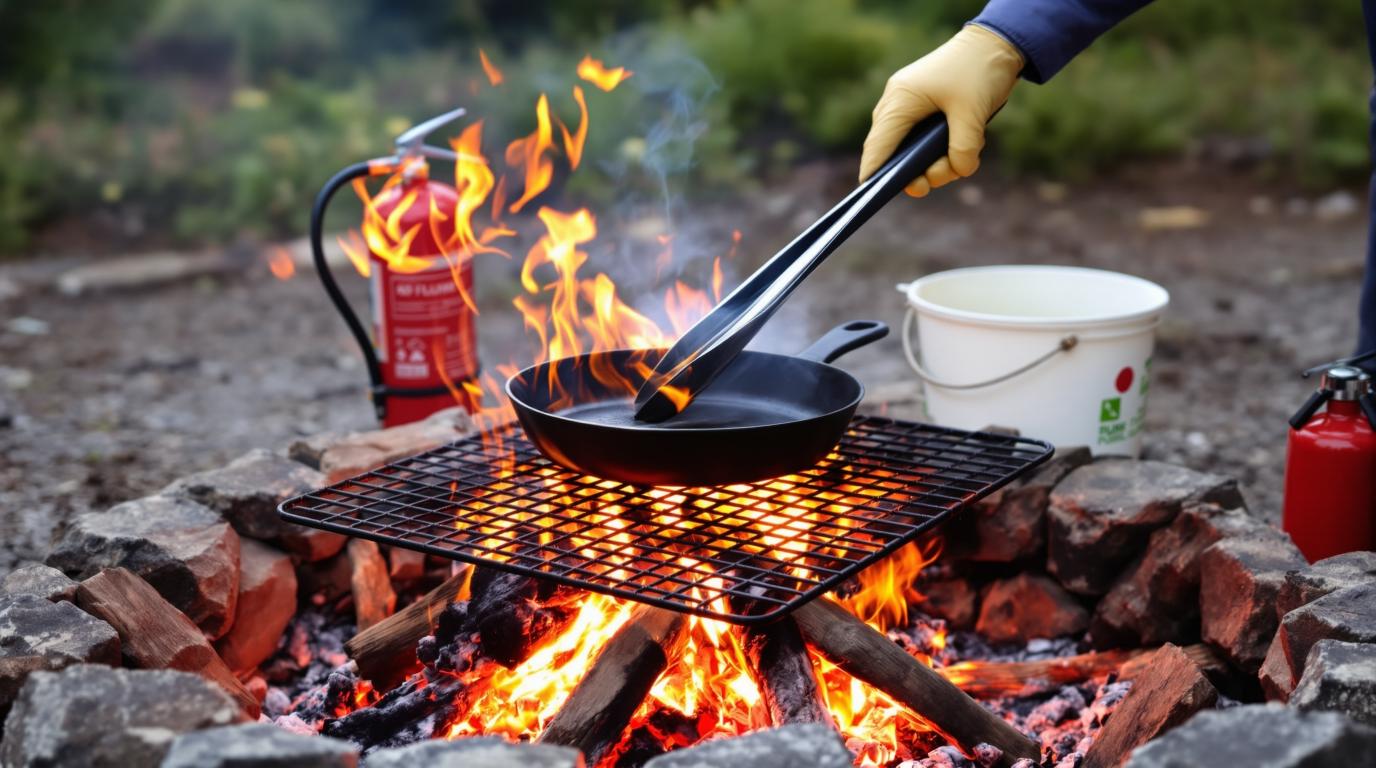
Cast iron skillets and pans can be placed directly on grates or coals.
Safety Tips:
- Only use cast iron or stainless steel (never nonstick pans—they release toxic fumes at high heat)
- Wear leather gloves when handling—the entire pan, including the handle, gets extremely hot
- Turn handles away from the flames so you don’t accidentally knock them
- Place pans on a stable, level surface
- Watch for hot oil splatters
- Keep a lid handy to smother any grease fires
Dutch Oven Cooking
Dutch ovens are perfect for stews, soups, and slow-cooked meals.
Safety Tips:
- Use a sturdy tripod if suspending over fire
- If placing on coals, create a stable bed of coals first
- Use a proper lid-lifter tool—never try to remove a hot lid with your hands
- The entire pot stays hot for a long time after cooking
- When opening, lift the lid away from you to let steam escape safely
- Don’t overfill (leave 2-3 inches of space at top to prevent boil-overs)
Foil Packet Cooking
Wrapping food in foil and cooking it in coals is foolproof—if you follow safety rules.
Safety Tips:
- Use heavy-duty foil and double-wrap for protection
- Create a “handle” by crimping extra foil at the ends
- Use long tongs to place and remove packets—never use your hands
- Let packets cool for 2-3 minutes before opening
- Open away from your face and body (steam can cause severe burns)
- Be careful of hot liquid inside packets
Roasting on Sticks
The classic method for hot dogs, marshmallows, and kebabs.
Safety Tips:
- Use metal skewers or green wood sticks (never dead, dry wood that can burn)
- Keep a safe distance from flames (at least 3 feet)
- Don’t let children run with pointed sticks
- Watch for food dripping hot liquid
- Food can catch fire—blow it out immediately if it does
- Rotate food frequently for even cooking
Burn Prevention and First Aid
Despite your best precautions, burns can happen. Here’s what you need to know.
Preventing Burns
Test everything before touching. Hover your gloved hand near an item to feel for heat before grabbing it.
Assume everything is hot. That pan you pulled off the fire 10 minutes ago? Still hot. That stick you used to poke the fire? Hot at both ends now.
Watch for steam. Opening Dutch ovens, foil packets, and covered pans releases superheated steam. Always open lids away from yourself.
Keep drinks away from the fire area. Someone trips, spills coffee, and instinctively reaches out—grabbing the hot grill grate to catch themselves.
First Aid for Burns
Minor Burns (First-Degree): Red skin, no blisters
- Cool under running water for 10-20 minutes
- Do NOT use ice (causes more damage)
- Cover with clean, dry cloth
- Over-the-counter pain relief if needed
- Should heal in a few days
Moderate Burns (Second-Degree): Blisters, very painful
- Cool with water
- Do NOT pop blisters (infection risk)
- Cover with sterile gauze
- Seek medical attention if larger than 3 inches
- May take weeks to heal
Severe Burns (Third-Degree): Charred or white skin, may not be painful (nerve damage)
- Call 911 immediately
- Do NOT remove clothing stuck to burn
- Cover with clean cloth
- Treat for shock (keep victim warm and lying down)
- Do NOT apply ointments, butter, or home remedies
- Victim needs emergency medical care
If someone’s clothing catches fire: Stop, drop, and roll. Smother flames with a fire blanket if available. Once flames are out, treat burns and seek medical help.
Conclusion
Cooking over open flames connects us to thousands of years of human tradition. It’s satisfying, it’s social, and when done right, it produces food with flavors you simply can’t achieve any other way.
But that “when done right” part is critical. Open fire cooking demands respect, preparation, and constant attention to safety. It’s not the place for shortcuts or carelessness.
The good news? Following the guidelines in this article makes fire cooking safe for everyone. Start with the basics: check your location, gather proper equipment, build an appropriate fire, follow the ten cardinal rules, and stay vigilant every moment.
Begin with simple foods like vegetables or pre-cooked items while you build your skills. As you gain confidence and experience, you can tackle more complex cooking techniques.
Most importantly, never let your guard down. The moment you think “just this once” or “it’ll be fine” is the moment accidents happen. Every single time you cook over fire, run through your safety checklist. Every single time, maintain safe distances and keep your emergency equipment ready. Every single time, extinguish completely.
With practice, these safety habits become second nature. You’ll find yourself automatically positioning the water bucket, checking wind direction, and wearing proper clothing without even thinking about it.
Now you’re ready to enjoy the incredible experience of cooking over open flames—safely. Gather your friends and family, build that fire, and create memories that will last a lifetime. Just do it the right way.
Happy (and safe) cooking!
Frequently Asked Questions
1. What’s the safest way to start a cooking fire?
The safest method is building a small teepee or log cabin structure with dry kindling and small logs, then lighting it with long matches or a fire starter. Never use gasoline, lighter fluid, or accelerants on an existing fire—these can cause explosions. Start small and gradually add larger pieces as the fire establishes. Allow 30-45 minutes for the fire to burn down to cooking coals.
2. How far should my fire be from my house or tent?
Maintain at least 20-25 feet between your fire and any structure—house, shed, garage, fence, tent, or vehicle. This distance protects against flying sparks and radiant heat. If local codes require more distance, follow those regulations. Never cook under overhangs, decks, or covered patios due to fire and carbon monoxide dangers.
3. Can I cook on a fire pit on my wooden deck?
This is generally not safe and may violate local fire codes. Wood decks can ignite from radiant heat and falling sparks even if you use protective barriers underneath. If you must cook on a deck, use a raised gas or propane fire pit specifically designed for decks, placed on a fireproof mat. Check local regulations first—many areas prohibit any open flames on wood decks.
4. What should I wear when cooking over open flames?
Wear natural fiber clothing only—cotton, wool, or leather. Avoid synthetics (polyester, nylon, fleece) that melt and stick to skin. Choose fitted long sleeves and long pants (not loose or flowing). Wear closed-toe leather boots or sturdy shoes. Tie back long hair securely. Remove all jewelry (metal heats up quickly). Use heat-resistant leather or silicone gloves—not regular cotton oven mitts.
5. Is it safe to cook with pine or cedar wood?
No. Pine, cedar, and other softwoods contain high amounts of resin that creates excessive smoke, sparks, and creosote buildup. The smoke can make food taste bad and may contain toxins. Use seasoned hardwoods instead: oak, hickory, maple, ash, or fruitwoods (apple, cherry). These burn cleaner, hotter, and longer, providing better heat control for cooking.
6. What do I do if my clothing catches fire?
Immediately Stop, Drop, and Roll. Stop moving (running feeds oxygen to flames), drop to the ground, cover your face with your hands, and roll back and forth to smother flames. If someone else’s clothing catches fire, push them down and smother flames with a fire blanket, heavy coat, or by rolling them. Once flames are out, cool burns with water and seek immediate medical attention.
7. How do I put out a grease fire on an open flame?
Never use water—it causes burning grease to explode and spread. Instead: (1) Slide a metal lid over the pan to smother flames, (2) Use a fire extinguisher aimed at the base of flames, (3) Smother with sand or dirt, or (4) If the fire is small and contained, let it burn itself out. Keep a lid and fire extinguisher readily accessible whenever cooking greasy foods.
8. Can I leave a fire unattended for “just a minute”?
No. Never. Not even for 30 seconds. Fires change instantly—wind shifts, logs roll, grease flares up, children approach. If you must leave, either extinguish the fire completely or have someone else watch it until you return. Assign one person as the dedicated fire-watcher if the cook needs to step away. This rule has zero exceptions.
9. What’s the best fire extinguisher for outdoor cooking fires?
Get an ABC-rated extinguisher that’s at least 10 pounds. ABC extinguishers work on wood fires (Class A), grease/oil fires (Class B), and electrical fires (Class C). Check the pressure gauge monthly—if the needle isn’t in the green zone, the extinguisher needs recharging. Keep it within 10 feet of your fire and make sure everyone knows where it is and how to use it.
10. How do I know when the fire is safe for cooking?
Wait for the initial flames to die down and wood to burn into glowing coals—usually 30 to 45 minutes after lighting. Coals should be white or gray with a red glow underneath. This stage provides steady, even heat without dangerous leaping flames. You can test by holding your hand at cooking height (where food will be): if you can only hold it there for 3-4 seconds, the heat is right for high-heat cooking.
11. Is it safe to cook in windy conditions?
Generally no. If sustained winds exceed 10 mph, postpone your cooking. Wind causes unpredictable flames, blows sparks onto flammable materials, and makes heat control nearly impossible. Gusts over 15 mph are extremely dangerous. If you must cook in light wind (under 8 mph), create a windbreak using stacked firewood or rocks upwind from the fire, and watch for flying sparks constantly.
12. What foods are dangerous to cook over open flames?
Avoid very fatty meats (bacon, ribeye steaks) that drip excessive grease and cause dangerous flare-ups. Don’t cook foods requiring precise temperature control (like delicate fish or custards)—open fires are too unpredictable. Avoid dairy-based dishes that spoil quickly. Never partially cook meat over fire and then finish it later—this creates food poisoning risks. Stick with dense vegetables, pre-cooked items, and foods that tolerate temperature variation.
13. How do I treat a burn from fire cooking?
For minor burns (red, no blisters): Cool under running water for 10-20 minutes, never use ice, cover with clean cloth. For moderate burns (blisters): Cool with water, don’t pop blisters, cover with sterile gauze, seek medical attention if larger than 3 inches. For severe burns (charred or white skin): Call 911 immediately, don’t remove stuck clothing, cover with clean cloth, treat for shock. Never apply butter, oils, or home remedies to burns.
14. Can children help with open fire cooking?
With proper supervision, older children can learn safely. Children 0-5 should never be near open flames—create a designated play area at least 10 feet away. Ages 6-10 can observe from 6+ feet under constant supervision but shouldn’t touch equipment. Ages 11+ can help with simple tasks (stirring, checking temperatures) under direct adult supervision. Assign one adult as dedicated child-watcher separate from the person cooking. Never allow children alone at fires.
15. Do I need a permit to cook over an open fire?
It depends on your location. Many areas require permits for recreational fires, especially during dry seasons. National forests often require campfire permits. Cities may prohibit open fires entirely or restrict them to certain times. Some counties have burn ban seasons. Always check with your local fire department or forest service before cooking. Fines for illegal fires can exceed $1,000, and you’re liable for any damage your fire causes.
16. What’s the safest way to extinguish a cooking fire?
Stop adding fuel 30+ minutes before you’re done. Let fire burn to small coals. Spread coals with a shovel. Pour water slowly over all coals (avoiding steam). Stir ashes and coals. Add more water. Repeat until you hear no hissing. Test by hovering your hand over ashes from a safe distance—if you feel heat, repeat the process. Never leave until coals are completely cold to the touch. Hot coals can reignite hours or even days later.
17. How do I avoid carbon monoxide poisoning?
Never cook over open flames in enclosed spaces—tent, garage, covered patio, screened porch, or indoors. Carbon monoxide is an odorless, invisible gas that kills. Even partial enclosures can trap deadly CO. Always cook in open air with good ventilation on all sides. If you’re cooking and start feeling dizzy, nauseous, or develop a headache, move away from the fire immediately—these are early CO poisoning symptoms.
18. What should I do if the fire gets out of control?
If the fire is small (contained to a pan), slide a lid over it to smother flames. For medium fires (spreading beyond original source), use your fire extinguisher with the PASS method (Pull, Aim, Squeeze, Sweep) and evacuate people from the area. For large fires (out of control), evacuate everyone immediately, call 911, and only attempt to fight the fire if you have a clear escape route. Never risk your life to save property. Your safety comes first, always.